
Tarzan
The enduring ape-man

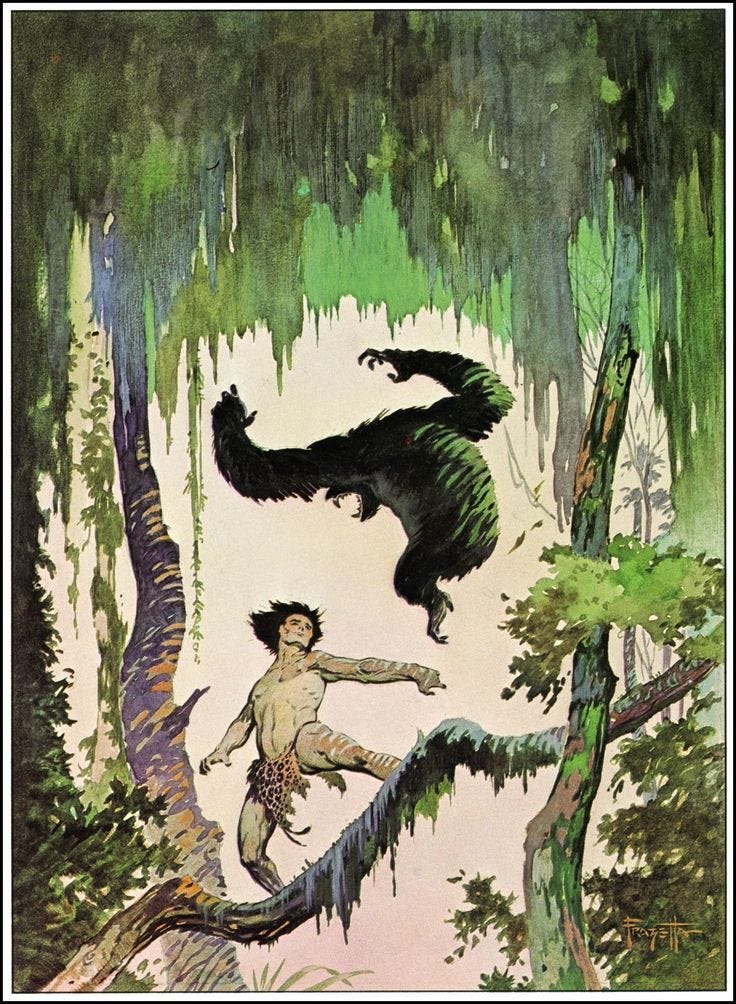
Whenever I mention Tarzan, most of the people I talk to know only the Disney film. A few old-timers will recall seeing the Johnny Weissmuller Tarzan movies, or perhaps Gordon Scott, or Ron Ely in the TV series. Not many have read the books, or even know that there were books written. Now, the Disney film is not a bad movie; it’s quite good, and it gets a few things right about Tarzan which earlier film portrayals missed. But it’s not the books.
For well over a century, audiences all over the world have enjoyed tales of the man raised by apes in the jungles of Africa. Edgar Rice Burroughs first published Tarzan of the Apes all the way back in 1914, after a long history of failed businesses. Broke, and desperate to feed his wife and children, he sent the manuscript to a pulp magazine, which published the story as a serial that year. It was a success. Everyone loved the ape-man. But why? What is it about Tarzan that has captivated audiences for so long?
Tarzan is a character that represents all that is wild and virile in man. He is our savagery and our wild spirit that, while tamed by virtue, is not a slave to the false faced of the civilized world. Yet, he is able to navigate both the jungles of Africa, the streets of Paris, and the halls of Parliament with equal ease. Yes, this is one of the things that the Disney film failed to cover; Tarzan is an English lord. John Clayton, Lord Greystoke is his actual name and title. He is an integrated man, who’s savage heart has been made gentle by the love of a woman.
Tarzan has almost everything a man might want. He is extremely strong and physically imposing from spending his youth living among the apes. He can handle most weapons, ride a horse, fight wild beasts with nothing but his bare hands and a knife. He has a large estate in Africa, and loyal friends who would stop at nothing to aid Tarzan. He speaks multiple languages, and has traveled the world. He has a beautiful wife and a son who he loves. Who wouldn’t want to be like Tarzan?
But Tarzan also represents our longing for more, and our disappointment with modern life. Though he has fought his way to the top of the dominance hierarchy of the Mangani Apes, this is not enough for him. He wants to meet people like himself, to live as a man, like the men he sees in the picture books he found in his parents’ hut. He has grown tired of his banal existence among apes that could never truly understand him, too small-minded to ever be able to grasp Tarzan’s aspirations.
Once he finally meets civilized men, and visits the world outside the jungle, he is disappointed with how shallow and false everything and everyone is. Tarzan, at his core, is an honest man. Lies, falsehood and pretense is foreign to his nature, and I think this resonates with too many young men. This is why he eventually rejects civilized life in Paris and London and returns to Africa; there he can surround himself with honest men and live the life he wants to live.
As it says in Tarzan and Jewels of Opar:
To Tarzan of the Apes the expedition was in the nature of a holiday outing. His civilization was at best but an outward veneer which he gladly peeled off with his uncomfortable European clothes whenever any reasonable pretext presented itself. It was a woman’s love which kept Tarzan even to the semblance of civilization—a condition for which familiarity had bred contempt. He hated the shams and the hypocrisies of it and with the clear vision of an unspoiled mind he had penetrated to the rotten core of the heart of the thing—the cowardly greed for peace and ease and the safe-guarding of property rights. That the fine things of life—art, music and literature—had thriven upon such enervating ideals he strenuously denied, insisting, rather, that they had endured in spite of civilization.
“Show me the fat, opulent coward,” he was wont to say, “who ever originated a beautiful ideal. In the clash of arms, in the battle for survival, amid hunger and death and danger, in the face of God as manifested in the display of Nature’s most terrific forces, is born all that is finest and best in the human heart and mind.”
But above all, I think we love Tarzan’s moral compass. He is ever gentle to Jane and all weaker things. He treats everyone with honesty and respect as far as he is able. Yet he is savage in his resistance to evil. At the end of the second Tarzan novel, The Return of Tarzan, Tarzan confronts the Russian Spy, Nikolas Rokoff, who has been nothing but a pestilence to both Tarzan and Jane the entire novel. Instead of killing him when he had the ability, Tarzan hands Rokoff over to the French authorities, who take him into custody. In the next book, however, when Rokoff returns to take revenge on Tarzan by kidnapping his wife and son, the ape man is not so merciful. Some evils should not be allowed to continue.
Is he perfectly moral all the time? No. But no truly good man is entirely free from sin; the virtuous man is the one who repents and confronts evil.
And this is why Tarzan has been a pop culture hero for so long.
Thanks for reading and be sure to subscribe and share this with your friends so that they can also enjoy my content.